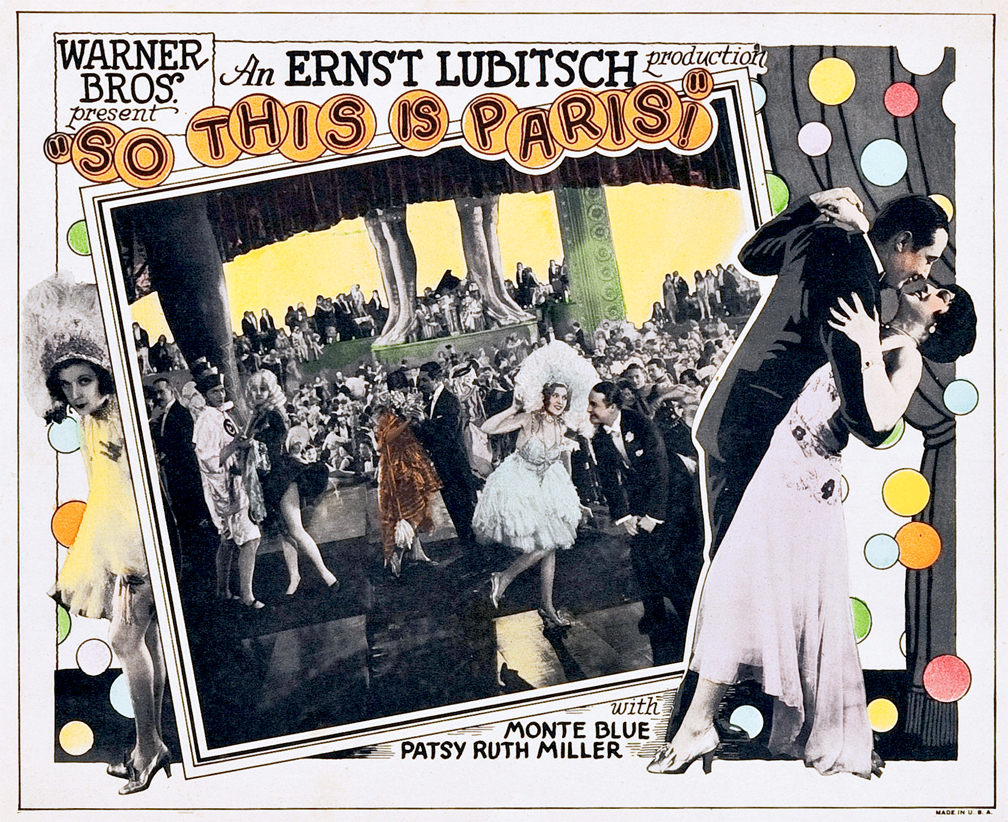
I’m pleased as punch to see that the Ernst Lubitsch silent film So This Is Paris (1926) has been getting a boost in notoriety in the last few years. Previously, it hadn’t been screened as often as the other Lubitsch silents. Sometimes it just takes one person programming a movie, one that’s undeservedly overlooked, that gets it launched toward being considered a classic. I’ve seen this happen with some silent films I’ve taken an interest in and have booked for shows that I’ve accompanied.
One of the things I have learned about film programming is that other film programmers look at each other’s work and lift or borrow film selections other people’s series. “If someone else has shown [fill-in-the-blank], maybe we should, too.” I often recommend to fans either on social media, here on my blog, or on my podcast that if there’s a silent film you believe deserves to be seen more often, the most effective way to get it noticed either for theater screenings or for home video is to get that film programmed at a local art house or classic film festival.
I’m a fan of Ernst Lubitsch’s silent films, and two of my favorites are The Marriage Circle (1923) and, especially, Lady Windermere’s Fan (1925). At some point in 2014 or 2015, I got to view So This is Paris in 35mm at the Library of Congress, and then we programmed the film at The Silent Clowns Film Series in NYC in 2016. Although I was unavailable to play or attend the show (Makia Matsumura was the accompanist), I heard from several people that the film went over really well, even better than I’d been expecting it to.
I spent a few years during the late 2010s pitching ideas to TCM for some kind of project that involved a silent film that Warner Brothers owned the rights to, and getting it scored by me for airing on TCM. So This Is Paris was released by WB, and it wasn’t due to enter the public domain until 2021, and this seemed like a good fit for the kinds of silents aired on the network. Eventually, a scenario got worked out so that this could move forward, and a scan of WB’s own archival material was sourced for the project.
I recorded my theatre organ score in March of 2020, finishing my recording work the week before everything shut down because of the COVID pandemic. The online edition of the TCM Classic Film Festival in 2021 had only one silent film on its slate of films: the new edition of So This Is Paris with my score. This new edition got its broadcast premiere on TCM in May 2021, and has been aired a few other times since then.
The by-product of this meant that there was now a digital edition of the film that could be booked, for venues that could not present the 35mm print from the Library of Congress. Between occasional airings on TCM and film programmers seeing that other programmers were booking this film for screenings, on DCP or on 35mm film, So This is Paris has gotten back out to fans a little more frequently and is enjoying a renaissance of interest. For instance: So this is Paris will be shown in two places on Sept 13, 2026 — the Los Angeles Silent Film Festival and on TCM’s Silent Sunday Nights.
I’ve seen this same ripple effect start to happen for Roland West’s The Bat (1926), a film that my company Undercrank Productions restored digitally and released on Blu-ray in 2025. It had been untouched by programmers for nearly 3 decades, but this year alone it has now had screenings at HippFest (Bo’ness, Scotland), the Los Angeles Silent Film Festival, the VisArt Video & Café (Charlotte NC), and will be shown at the Norman Studios Museum (Jacksonville FL) in October.
I encourage anyone programming silent film for their theater to book So This is Paris — or anything else they think deserves to be shown — and to contribute to the ripple effect of film programming.
Leave a Reply
You must be logged in to post a comment.